Why Was Hitler Rejected from Art School? A Complete Guide to His Failed Applications
Why was Hitler rejected from art school? His applications to the Vienna Academy of Fine Arts failed because his artistic style lacked the qualities the academy sought, especially in human figure drawing. Despite having developed strong skills in architectural and landscape painting, he struggled with the academy’s focus on figure composition, leading to multiple rejections. Starting with improving figure drawing skills could have made a significant difference.
Key Takeaways
- The Vienna Academy accepted about 75% of applicants in 1907, so rejection meant Hitler’s work notably missed their criteria.
- Hitler’s classical but conservative style clashed with the academy’s preference for dynamic figure drawings and broader artistic versatility.
- His repeated failures were partly due to weak human anatomy sketches, which were important for admission.
- External factors like his lack of formal secondary education and financial struggles influenced the quality and volume of his submissions.
- Vienna’s art scene favored modernist movements, which contrasted sharply with Hitler’s Romantic and architectural focus.
- Hitler produced around 2,000 paintings, but few demonstrated the imaginative or rhythmic qualities admired by the academy.
Why Did Hitler Fail to Get Accepted into Vienna’s Art Academy?
Adolf Hitler was rejected from the Vienna Academy of Fine Arts primarily because his drawing skills did not meet the academy’s standards for admission. In 1907, he submitted an application with landscape paintings and figure drawings, hoping to enter the school and pursue a career as a professional artist. Despite his confidence, the academy’s examiners found that his work lacked proficiency in human figure drawing, which was a critical skill for acceptance. This shortcoming led to his rejection, even though the acceptance rate that year was around 25%, meaning most applicants were admitted.
Hitler applied twice, first in 1907 and then again in 1908. Both times, the institution pointed out that while his architectural and landscape paintings showed some competence, his figure drawings were considered weak and uninspired. The academy emphasized the importance of accurately rendering the human form, a standard Hitler’s style failed to meet. His artwork was viewed as traditional and somewhat stale when compared to other applicants who presented fresher and more dynamic styles. This difference in artistic approach, combined with technical weaknesses, sealed his fate.
The rejection was not just about style but also technical skill. The academy’s feedback focused explicitly on the poor quality of Hitler’s live model drawings, which is why he could not advance beyond the preliminary tests. Unlike other candidates who displayed a balanced portfolio, Hitler’s submissions exposed his limited ability to depict human anatomy realistically. By late 1908, after the second rejection, Hitler faced financial hardship and was forced to abandon formal training, which altered his future path significantly.
How Competitive Was the Vienna Academy of Fine Arts Admissions Process?
The Vienna Academy of Fine Arts was highly competitive during the years 1907 and 1908. Approximately 1,000 applicants competed for admission each year, with only about 31 students accepted annually. This translates into an acceptance rate slightly above 3%, making entry extremely difficult.
The admissions process included rigorous entrance exams focused on technical drawing skills. Applicants were required to produce precise, well-executed architectural drawings and figure studies. The Academy’s standards favoured realistic representation and strong draftsmanship over abstract or experimental styles. This preference shaped which applicants were admitted, as the institution sought mastery of traditional techniques.
Hitler’s repeated attempts to pass the entrance exams illustrated the challenge of meeting the Academy’s expectations. While his paintings demonstrated technical competence, they lacked the bold creativity and fluidity the Academy expected in areas beyond strict realism. His style was considered prosaic and lacking in imaginative qualities, which the admissions criteria critically weighed. The table below illustrates the high competition and limited openings:
| Year | Number of Applicants | Number Accepted | Acceptance Rate |
|---|---|---|---|
| 1907 | ~900 | 31 | ~3.4% |
| 1908 | ~1,000 | 31 | ~3.1% |
The admissions criteria emphasized accuracy in perspective, proportion, and architectural detail. Those qualities reflected the Academy’s prioritization of classical traditions, despite the contemporary Vienna Secession movement’s growing influence on abstract and experimental art. This clash between conservative selection and evolving artistic trends explains part of the Academy’s low acceptance rate and why certain styles were preferred.
Handle the admissions process required more than talent, it demanded alignment with the Academy’s specific artistic values. Applicants who excelled in realistic, detailed drawing and showed potential for development in those areas stood the best chance of acceptance. Creative experimentation, especially with abstraction, was not rewarded in this context during that period.
What Was Unique About Hitler’s Artistic Style and How Did It Compare?
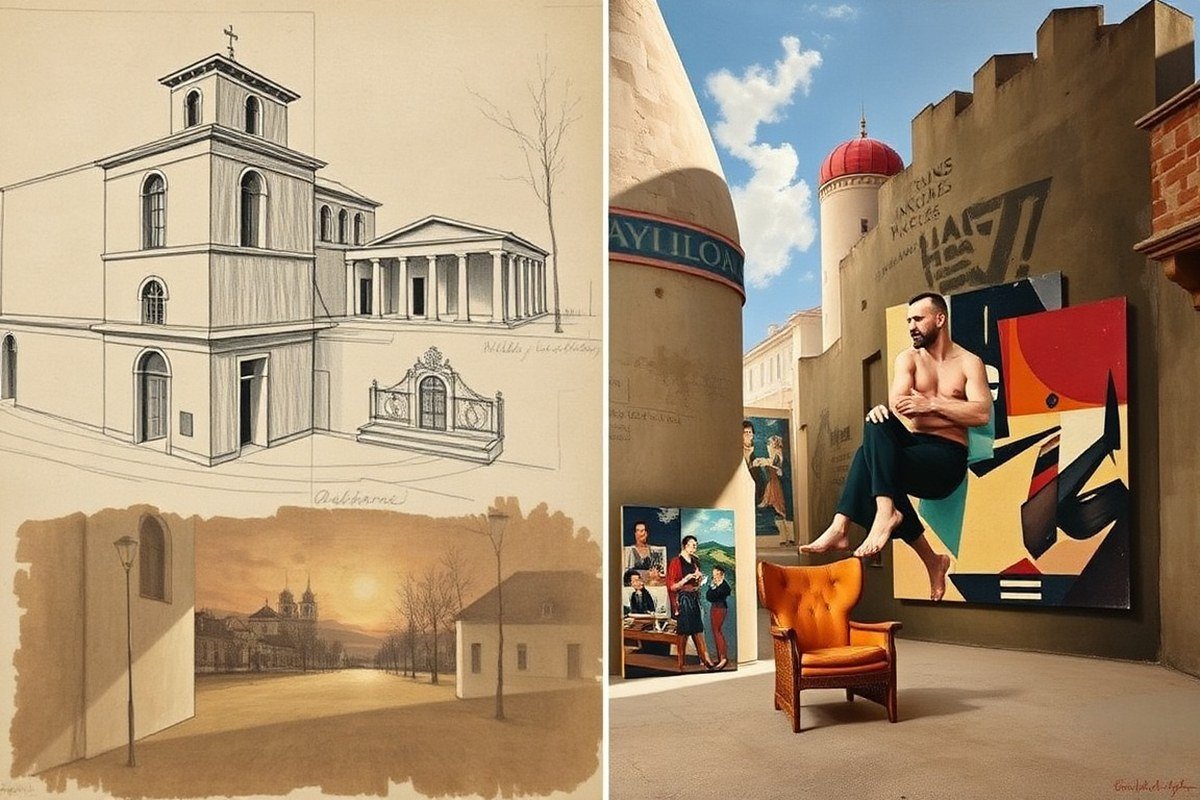
Hitler’s artistic style centered around classical and architectural motifs, with meticulous watercolors of buildings, courtyards, and landscapes. His paintings are characterized by precise lines and a calm symmetry, reflecting his strong interest in 19th century Romanticism and architectural forms. This focus on structure and environment shaped much of his output, often ignoring human figures or emotional expression.
Contrastingly, the Vienna Academy of Fine Arts prized a broader artistic skill set, especially the ability to capture the human form through live figure drawing, anatomy studies, and expressive, modernist techniques. Students were expected to demonstrate versatility and creativity in both traditional and contemporary styles. Modernist trends at the time emphasized bold experimentation, emotional content, and a break from classical architectural rigidity, which clashed with Hitler’s restrained and formulaic approach.
| Art Aspect | Hitler’s Style | Academy’s Preferred Style |
|---|---|---|
| Subject Matter | Architecture, landscapes, detailed buildings | Human figures, expressive subjects, modern themes |
| Technique | Precise, symmetrical, realistic watercolors | Dynamic brushwork, varied mediums, emotional depth |
| Artistic Approach | Academic revival of classical forms, Romanticism | Modernist movements including Expressionism, Secession |
His concentration on architectural accuracy, while impressive, neglected the academy’s requirements for a more complete skill set, especially in anatomical knowledge. The academy’s entrance exam involved drawing human figures and passing tests covering art history and modern artistic techniques, areas in which Hitler’s work showed notable gaps. This disconnect from the modernist zeitgeist, dominated by evolving worldviews and new artistic philosophies, contributed significantly to the rejection of his applications.
Examples of accepted works from the academy’s era often featured lively, emotionally charged interpretations of human form, unlike Hitler’s detached and static buildings. His paintings, though technically competent in perspective and detail, lacked the creativity and vitality demanded by the academy, pointing to why his style did not align with their standards despite producing around 2,000 works during his life.
How Did Personal and External Factors Influence Hitler’s Repeated Rejections?
Hitler’s lack of formal art education was a significant factor in his repeated rejections from art school. He did not receive structured training in fundamental skills such as figure drawing, which were essential requirements for admission to the Vienna Academy of Fine Arts. Applying for the first time in 1907 when he was 18, he was deemed insufficiently trained to handle the human form, a skill rigorously evaluated by the academy.
His personality also played a role. Contemporary accounts and later psychological analyses suggest Hitler had a stubborn, rigid temperament that likely hindered his ability to adapt to criticism or improve according to feedback. Such traits can limit artistic growth, making it difficult to meet the expectations of rigorous academic institutions. This inflexibility, combined with a sensitive self-image, made the back-to-back rejections a heavy emotional blow and possibly discouraged him from seeking formal instruction elsewhere.
Financial and social struggles further complicated his path. After his father died, Hitler lost family support and had no steady income. Around 1908 to 1910, he lived precariously in Vienna, surviving mainly by selling roughly one painting per day, earning about 5 Kronen each. This income was modest and unreliable, restricting his access to materials, lessons, and exposure to broader artistic circles. His social isolation prevented networking opportunities that often help young artists gain mentorship and acceptance.
The combination of lacking formal training, a challenging personality, and financial hardship created a scenario where progress was extremely difficult. Persistent rejections were not merely due to skill but also reflected the emotional and economic pressures on a young artist trying to break into a competitive field without the usual support systems. This context helps explain why his artistic ambitions stalled despite passionate dedication during those years.
What Were the Consequences of Hitler’s Art School Rejections on His Life?
After being rejected twice from Vienna’s prestigious art academy, Hitler faced immediate financial hardship, living in poverty while trying to sell watercolor paintings of architectural scenes and flowers. This struggle marked a sharp turn in his life. Instead of pursuing a professional career as an artist, he drifted into a fringe existence surrounded by political pamphlets and disillusionment.
The rejection triggered a psychological impact that contributed to Hitler’s deepening bitterness and reinforced his developing ideology, including his anti-Semitic views. These views may have subtly appeared in his conversations and possibly even in his art, which was limited to watercolors painted indoors from postcards rather than original scenes. Unlike the innovative artists of his time in Vienna, who embraced symbolism and emotional depth, his style remained conservative and detached from the avant-garde movements reshaping the art world.
Eventually, Hitler enlisted in the German military during World War I. His military service and the political upheaval afterward became the turning points that shifted his ambitions from art toward politics. His experiences in the trenches and the postwar environment shaped his ideas about national identity, struggle, and leadership, which he then expressed in speeches that echoed themes of a grand mission or destiny.
Had Hitler been accepted into art school and succeeded as an artist, some historians speculate that the course of history might have been different. With a stable career and outlet for his creativity, he might not have entered politics or had the platform to spread his ideology. However, this is hypothetical and impossible to prove. What is clear is that the art school rejections set him on a path that had profound consequences for Europe and the world.
The shift from aspiring artist to political figure also colored Hitler’s later views on culture and art, which became tools for propaganda and control. His embrace of a narrow, state-approved aesthetic reflects the contrast between what might have been a diverse artistic career and the uniformity he demanded politically.
Understanding Hitler’s Art School Rejections: A Clear Plan
To grasp why Hitler was rejected from art school, follow this step-by-step approach that breaks down key factors and their effects.
- Start with Historical Context: Research the admission standards and competitiveness of Vienna’s Art Academy around 1907. Check if you understand that the academy emphasized drawing skills from life and architecture.
- Assess Artistic Style: Compare Hitler’s submitted works with the academy’s preferred styles, noting his focus on landscapes and buildings rather than human figures. Confirm you can identify differences in technique and subject matter.
- Examine Personal Influences: Look into external factors like Hitler’s family situation and mental state, judging how these could have affected his preparation and motivation. Verify if you see a link between these factors and his repeated rejections.
- Study the Admission Process: Understand the multiple layers of the admissions process and how competitive it was, especially for the drawing exams. Test your knowledge by outlining why many applicants failed, not just Hitler.
- Explore Consequences: Identify how the rejections influenced Hitler’s subsequent life choices and ambitions beyond art. Confirm that you can explain this shift clearly.
- Summarize Insights: Write a brief summary of why Hitler failed to get accepted, focusing on specific reasons and the competitive environment. Check if this summary aligns with documented facts about the academy and Hitler’s circumstances.
- Engage with Visuals: Look at available reproductions of Hitler’s artwork and examples of accepted art from the same period. Decide if the differences support your understanding of the rejections.
- Reflect and Discuss: Share your findings with others interested in history or art, noting any questions or insights that deepen your grasp of why the rejections mattered.
Frequently Asked Questions
Could Hitler Have Succeeded If Accepted into Art School?
Eric-Emmanuel Schmitt’s novel imagines Hitler accepted, suggesting his life would have taken a very different path, possibly avoiding his later political and military actions. This fictional scenario highlights how important the rejection was to his history.
Did Hitler’s Family Support His Art Ambitions?
Hitler’s family, especially his father, disapproved of his artistic goals, preferring a more stable career for him. This lack of support added pressure and may have affected his confidence during admission attempts.
What Role Did Hitler’s Personality Play in His Rejection?
Hitler’s inability to accept criticism and his high-strung behavior likely hurt his chances, as art schools value openness to feedback for growth. His personality issues extended back to childhood.
How Did the Art Academy Evaluate Applicants’ Skills?
The Vienna Academy emphasized drawing skills, especially of the human figure, for entrance exams. Hitler excelled in architectural subjects but struggled with people, which partly explains his rejection.
Was Hitler’s Art Rejection Common Among Aspiring Artists?
Nearly 25% of applicants were rejected despite the academy accepting 75%; being among the rejected was not unusual. However, Hitler’s persistence in reapplying shows his strong commitment despite setbacks.
Wrapping Up
Hitler’s rejection from art school came down to a mismatch between his artistic style and the academy’s standards, combined with personal challenges and a highly competitive admission process. These refusals shaped his life path away from art and towards politics. To deepen your understanding, examine actual exam requirements and compare them to Hitler’s surviving artworks. That direct study reveals the clear reasons behind the rejections and their lasting impact.